
10 Tips For Using a 50mm F1.8 Lens
These tips for using the Canon 50mm F1.8 lens is everything I wish someone had told me when I first picked one up!
The 50mm f/1.8 is one of the most recommended lenses in photography, and for good reason!
It's affordable, lightweight, incredibly versatile, and truly is capable of producing stunning images (when you know what to do with it 😉)
Whether you're shooting with Canon, Sony, Nikon, or any other brand, this humble "nifty fifty" lens is often the first prime lens a photographer ever buys - myself included!

I first got this lens around 14 years ago (and yes, it’s still in my camera bag!) when I was shooting with a Canon Rebel T3i.
Coming from a kit lens that topped out at f/4.5, having a lens where I could shoot at F1.8 felt amazing, and initially I was freaking delighted with it!
But then I noticed my images weren’t very sharp, I couldn’t use it for the types of photos I wanted, and I would struggle in certain situations.
So consider this the guide I wish I’d had when I first got this lens.
Whether you've just unboxed your first 50mm, or you've had one for a while and just want to get more from it, I’m pretty damn sure these tips will help you. (Heck, they’ll help with ANY lens!!)
Let’s dive in!
Tip 1 - Don’t Shoot At F1.8 (just because you can 😉)
This is the number one mistake I made, so it totally deserves the top billing here. (Plus I’ve taught over 8,000 students, and I see it all the time with photographers who are new to fast prime lenses!)
The moment you get a 50mm f/1.8, the temptation to shoot wide open is almost irresistible, especially if you've been used to a kit lens that maxes out at something like f/3.5 or f/4.5.
I know when I first got mine I was shooting everything at f/1.8, because I really wanted those blurry backgrounds, and I didn’t know any better ☺️
What I didn't realise is that f/1.8 is actually the softest aperture this lens offers. It's where sharpness is at its weakest, chromatic aberration is most visible, and focusing errors are the most unforgiving!
(This is true of most lenses, by the way — not just the 50mm f/1.8. Shooting a lens wide open with most entry level lens always gives you the softest results. The glass simply can't perform at its best when it's working at full stretch. A bit like myself at the end of a long day)
KEY TAKEAWAY:
Unless you have a very specific reason for shooting at f/1.8 (extremely low light, or you aren’t too bothered about sharpness), try stepping up to f/2.8 or f/3.2.
You'll still get that gorgeous, creamy background blur, and you'll let in plenty of light, but your images will be noticeably sharper!
(Confused about which settings to use when? Get a free manual mode cheat sheet here!)
Tip 2: This Lens Is Sharpest Around f/5.6
If maximum sharpness is your goal, the sweet spot for the 50mm f/1.8 is somewhere between f/5.6 and f/8.
Again, this principle applies to almost all lenses — the middle apertures tend to give you the crispest, most detailed images.
KEY TAKEAWAY:
Detail shots, flat lays, food photography, landscapes, group portraits, or any situation where you want edge-to-edge sharpness rather than subject separation, go for that F5.6 to F8 aperture.
Tip 3: Watch Your Depth of Field!
Even shooting at f/2.8 or f/3.2 as I advised above, the depth of field can be incredibly narrow, and this is something that catches a lot of newer photographers out!
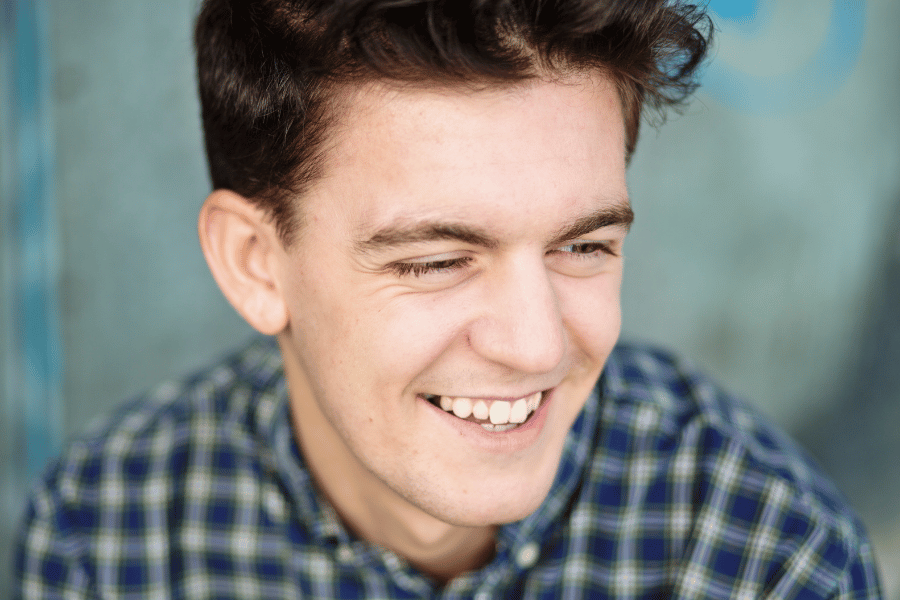
For example, below is a shot of mine where I focused on my subject's eye, only to find that their eyebrow was sharp but their eye wasn't! (this might be a tad more difficult to see when sized for web, but if you look at the right eyebrow, you’ll see that is razor sharp, but the eye….not so much 😂)
Now, to be fair, that's a focusing error on my part, but it's also just the nature of shooting with a shallow depth of field.
When the depth of field is just a centimetre or two deep, you better be damn sure that your focusing technique is spot on!
KEY TAKEAWAY:
If you're shooting portraits, focus specifically on the eyes — the near eye if your subject is at an angle. If you aren’t so good with focus, use a slightly smaller aperture to give yourself more margin for error.
📋 Want a free camera settings cheat sheet with suggested apertures, shutter speeds, and ISOs for different situations? Click here and I'll send it straight to you!
Tip 4: There’s a Minimum Focusing Distance
Every lens has a minimum focusing distance — the closest you can physically get to your subject and still achieve focus. The 50mm f/1.8 is no exception, and this tripped me up constantly when I first started out!
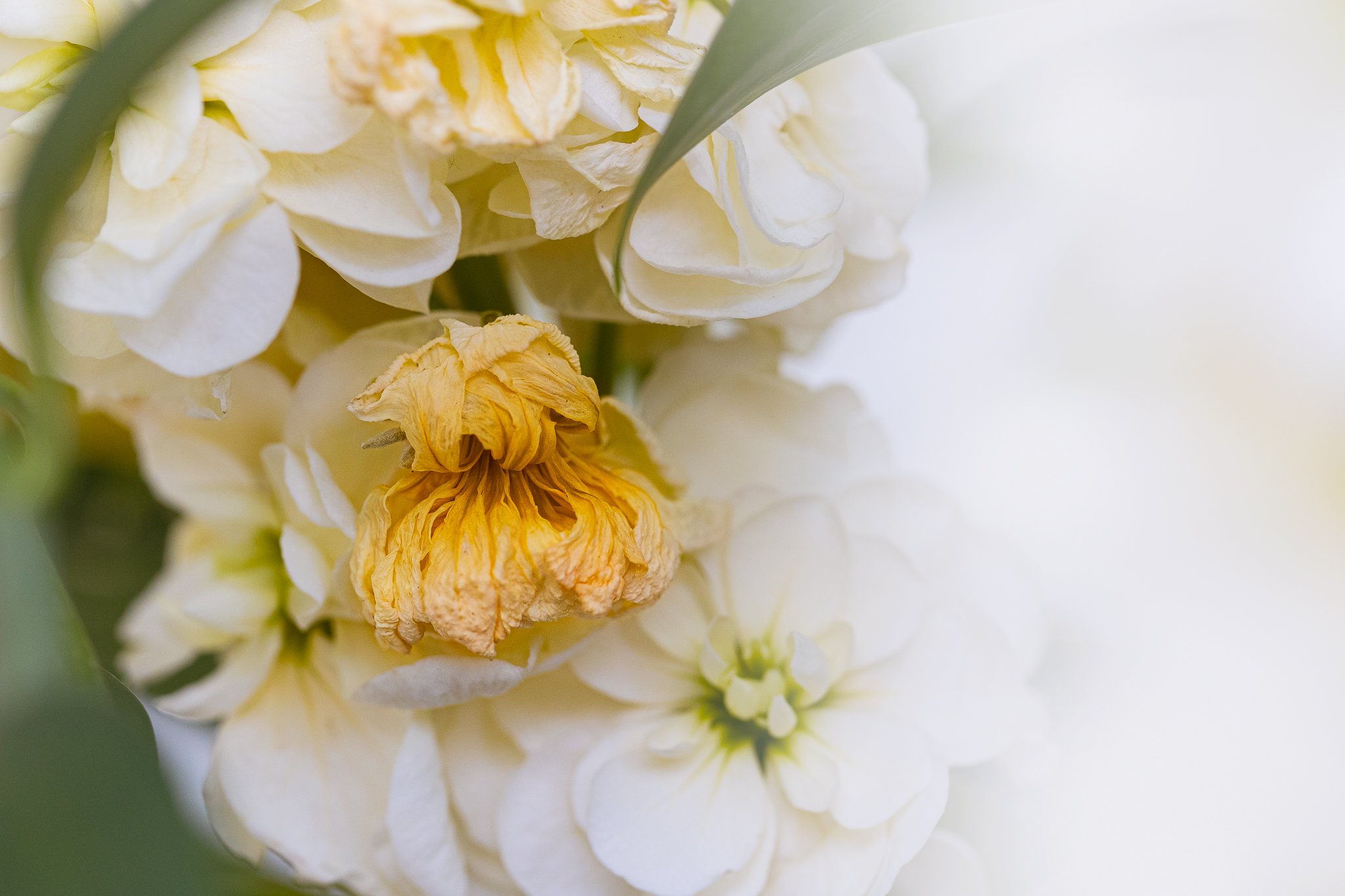
I was trying to take those beautiful close-up shots of flowers and small details, but every time I got too close, the lens would hunt back and forth, unable to lock on, which was, of course, totally frustrating/annoying.
The answer, of course, was simply that I was too close. Simple really!
KEY TAKEAWAY:
If you notice your lens hunting for focus and struggling to lock on, take a step back. You'll almost always find that moving slightly further away brings you into the lens's focusing range and everything clicks into place 😀
P.S Want to shoot close-ups? Look into a macro lens or a set of macro extension tubes or close-up filters, which attach to your 50mm and allow it to focus much closer than it normally could. They're a great, affordable way to get into macro photography!
Tip 5: On a Crop Sensor Camera, a 50mm Behaves Like an 80mm
This is the one that really caught me off guard when I first bought my 50mm!
I was shooting on a Canon crop sensor camera at the time (that Canon Rebel T3i I mentioned) and kept reading reviews about how versatile and "all-purpose" the 50mm was - perfect for street photography, documentary, portraits, everyday life — so I bought one expecting exactly…..that.
What those reviews didn't mention (or maybe they did and I just didn’t understand) was that these reviews were written for full frame cameras.
On a crop sensor camera, you need to multiply the focal length by your camera's crop factor (typically 1.5x for Sony/Nikon or 1.6x for Canon). That means my Canon 50mm was actually giving me a field of view closer to 80mm.
That's a portrait focal length, not a versatile all-rounder, damn you.
Indoors, I practically had to stand in the hallway to fit my (then small) son into the frame, so it wasn’t the documentary lens I'd bought it for.
The silver lining was that for portraits, it's actually brilliant on a crop sensor!
The 80mm equivalent gives you very flattering compression and it keeps you at a comfortable distance from your subject, so I ended up using it for that instead.
KEY TAKEAWAY:
If you're on a crop sensor and want a more versatile all-round focal length, look at something like a 35mm instead (I big puffy heart my Sigma 35mm F1.4 Art lens!)
On a crop sensor, that gives you roughly a 50mm equivalent — much better for everyday, documentary-style shooting, but can also be used for portraits, street etc.
(If all this talk of lenses, focal lengths, maximum apertures and crop factors is making your head spin, check out The Ultimate Lens Guide video workshop! It’s a mere $9, and it will explain everything in easy to understand, real life terms, and help you choose the right lens for you!)

Tip 6: On Full Frame, Be Intentional About Your Composition
Now that I shoot on a full frame Canon, the 50mm gives me something very close to the natural field of view of the human eye, making it a much more versatile lens.
But "versatile" can also be a code word for "a bit unremarkable" if you're not careful!
Because the focal length mimics normal human vision, your images won't have the dramatic compression of a telephoto or the interesting wide-angle distortion of a 24mm.
While that’s fine, you might have to work a little harder to make your compositions visually interesting!
KEY TAKEAWAY:
Change your shooting angle — get low, get high, look for leading lines. Use light creatively. The 50mm rewards photographers who think carefully about their frame rather than relying on the focal length to do the work for them!

Tip 7: Take Control of Your Focus Point
This lens can give you genuinely sharp images — but it needs you to tell it where to focus!
If you're leaving everything up to your camera's automatic focus area selection, you're essentially hoping that the camera guesses correctly what you want to be sharp. Sometimes it will….. but often, it won't.
The first thing you can do is switch from automatic area AF to a single focus point and choose that point yourself. Place it precisely over whatever you want to be sharp — usually the near eye in a portrait, or the most important element of your composition.
There’s a lot more to getting tack sharp images, but it’s a great first starting point if you’re new to photography!
KEY TAKEAWAY:
Letting the camera guess at focus means you'll regularly get shots that are ever so (or dramatically so!) soft.
And missed focus is one thing you really can’t fix, so your photos will end up in the delete pile for sure!
Take control of ALL aspects of focus, and I promise you’ll get much better photos!

Tip 8: Use the Manual Focus Override (Newer Canon Versions) if you need to
If you have a newer version of the Canon 50mm f/1.8 (the STM version), you'll have access to a manual focus override feature that lets you fine-tune your focus manually without switching the lens out of autofocus mode.
This means you can use AF to get you most of the way there, then turn the focus ring to dial it in precisely.
On older versions — like the one I have — you need to physically flip the switch on the side of the lens from AF to MF, focus manually, and then switch back (you’ll see an example of this switch below)
KEY TAKEAWAY:
Honestly, I rarely use manual focus, but if you do, then having this manual focus override without having to flip the switch just makes life that little bit easier!

Tip 9: Don't Forget Your Shutter Speed
A lot of photographers blame their lens when their images look soft — but often, the real culprit is shutter speed. Motion blur and camera shake can look very similar to a focus problem, and they're far more common than people realise.
As a general rule, your shutter speed should be at least the reciprocal of your focal length — so for a 50mm lens, at least 1/60th of a second. If you're shooting a moving subject, you'll want much faster than that.
KEY TAKEAWAY:
If your images look soft but your focus seems correct, check your shutter speed!
📋 My free camera settings cheat sheet covers suggested shutter speeds for different situations — from still portraits to moving subjects. Grab your free copy here!
Tip 10: This Is a Prime Lens — You Have to Move Your Feet!
The 50mm f/1.8 is a prime lens, which means there's no zoom ring. You can't twist the barrel to get closer or further away - so for example, if you want a tighter frame, you physically have to move towards your subject!
When I first made the switch from zoom lenses to primes, I won’t lie, this felt like a real limitation. But I've come to genuinely love it!
Moving your feet rather than zooming changes the way you engage with a scene. You think more carefully about your position, your angles, your distance from the subject.
I personally think it makes me a more intentional photographer. (I don't own a single zoom lens anymore. That probably says everything!)
KEY TAKEAWAY:
Being forced to move can actually be an advantage! Try circling your subject and shooting from multiple distances and vantage points.
Final Thoughts
50mm F1.8 lenses are FANTASTIC lenses for the price - you just need to know how to get the best from them!
The tips I’ve given you here should make real, specific improvements that allow you come away with images that are sharper, more interesting and more creative - which is the goal for any photo!
Of course, tips are one thing, but having all the pieces working together is the holy grail.
So if you want to learn more about choosing the right camera settings, getting tack sharp focus, and working faster in manual mode, along with how to use light and composition, check out Auto to Awesome!
Auto to Awesome is our comprehensive but ridiculously easy to follow 6- part program that gives you a complete FRAMEWORK to follow that will turn your images from boring, middle of the road snapshots, into wall worthy, professional level images!
We go over everything: from which camera settings to use, to how to shoot in manual mode, how to use light and composition effectively, and the steps for getting tack sharp focus (yes, even with erratic toddlers or flighty birds!) and accurate colour.
This course takes you by the hand and walks you through it ALL, step by step and setting by setting, so that this truly is the only photography course you'll need to start getting photos you love.
Check out Auto to Awesome here.
Frequently Asked Questions
Is the 50mm f/1.8 good for beginners?
Yes — it's one of the best first prime lenses you should buy. It's affordable, lightweight, and teaches you a huge amount about composition and exposure because you have to move your feet instead of zooming. The learning curve is part of the value 😉.
Why are my 50mm photos blurry?
The most common culprits are: shooting wide open at f/1.8 (the lens's softest aperture), a shutter speed that's too slow, being closer than the minimum focusing distance, or letting the camera choose the wrong focus point. Work through each of these and you'll almost certainly find the cause!
What aperture should I use for portraits with a 50mm f/1.8?
I'd recommend starting at f/2.8 or f/3.2. You'll get beautiful background separation and the lens will be considerably sharper than at f/1.8. If you're shooting full body or groups, f/4 or f/5.6 gives you more depth of field to work with.
Is the 50mm f/1.8 good on a crop sensor camera?
Yes, but it behaves more like an 80mm, which makes it excellent for portraits but less versatile for wider, documentary-style shooting. If you want a true 50mm-equivalent field of view on a crop sensor, look at a 35mm f/1.8 instead.
What is the minimum focusing distance of the 50mm f/1.8?
For the Canon 50mm f/1.8 STM it's 35cm (about 1.1 feet). If your lens won't lock focus, move back a step — you're almost certainly too close.
Why does the 50mm f/1.8 feel zoomed in on my camera?
If you're shooting on a crop sensor camera, that's completely normal. The crop factor (1.5x or 1.6x depending on your brand) means your 50mm is giving you a field of view equivalent to roughly 75–80mm on a full frame camera. It will feel more "zoomed in" than you might expect.