
Welcome to the blog!
Scroll down for the latest and greatest, filter by category, check out the most popular tutorials, or search for what you want to learn below!
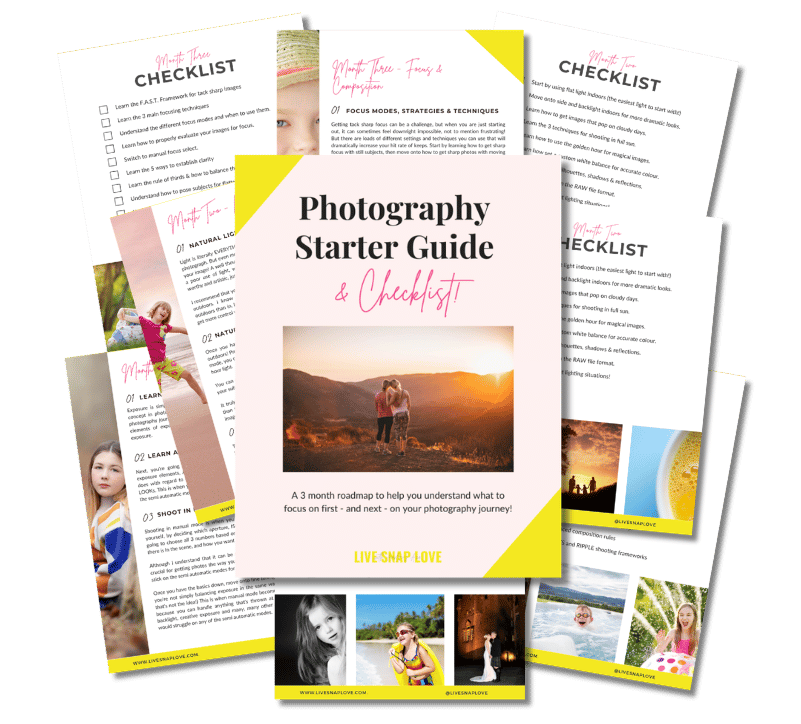
Want to learn photography but have no clue where to begin and what to learn next??!
Steal my Photography Learning Blueprint and get the clarity, checklist and step by step game plan to help you get photos you love - quickly!

What do the numbers on your lens mean?
I've covered a fair bit on lenses this past week, comparing different focal lengths and understanding lens compression, and I thought I'd rewind a bit for any new photographers, and talk about what the numbers on the lens mean.
This was one of my very first questions I had when buying my DSLR and it took me a little while to figure out! Hopefully this post will help break this down if you are new to lenses too.
So, let's take a look at some lenses and break down the numbers to see what they mean, and what you should look for.
Let's start with a lens that you will often see sold as a "kit lens" with your camera:

How to Work Out Your Depth of Field
To get tack sharp images, one element you need to be aware of is your Aperture. Aperture controls the depth of field - in other words, how much of your scene is going to be in focus. A smaller F number means you will have a smaller depth of field (less in focus) and a bigger F number means more will be in focus.
I have been asked many times about which aperture you should use for what, and whilst I always try to give guidance on that, the truth is that it very depends on the camera model you have, the lens you are using, how far away you are from the subject and the distance between yourself and what you are trying to get in focus.

What Is Lens Compression? And What does it do?!
When we choose a lens to take an image with, most of the time we are looking at how much we want to fit into the frame, and far away from our subject we are. For example, if you are shooting indoors in a small room, but you want to leave in some of the surroundings to give the image context, then you are going to want to choose a shorter focal length. If you are photographing something farther away, like your child at sports day, you are going to want to have a longer length lens on your camera, so you can be farther back but still have the whole of your child in the frame. In the post I did yesterday, you can see just how much more you can fit into the frame with a 35mm than a 200mm. (Check out the post on focal length comparisons if you missed it!)
As I mentioned in that post, there is another reason for using certain lenses over and above how near or far we are from our subjects, and that is the lens compression.

Focal Length Comparison
I finally got around to photographing focal length comparisons again this week - I know these can be really helpful as a reference point.
I gave up on trying to get someone to model for me - since one certain little boy wouldn't stay in the same place for long enough whilst I went through all my lenses (twice!) we have the lovely Dave as our model instead. I'm pretty fond of Dave, he's very obliging :)
So, each of these photos has been taken with a different lens, and therefore a different focal length, so you can see how your field of view changes with each one. For this first set I'm sitting in the same location for each shot, just changing my lens to get the different focal lengths. (If you are wondering which lens were used you can check out the lenses here)

How to Reduce Noise in Photos
Today, some tips for how to reduce noise in photos, both in camera, and in processing....
When shooting in low light conditions, we generally have to compensate for the lack of light in the scene by bumping up our ISO setting. This is great as it allows it to shoot without using flash, but the problem with using these high ISO's numbers is that it can introduce noise to your images - the stuff that looks like grain or speckles. This puts a lot of people off shooting with high ISO's, but there are a couple of things you can do to minimise the noise and get the best images in low light.

How to Care for your DSLR & Lenses
After investing all that money on your amazing new camera and lenses, it makes sense to spend a little time on DSLR maintenance to make sure that they stay in tip top condition. This is mainly so that you continue to get the best image quality and extend the life of your equipment, but it also helps should you want to sell on some of your equipment at any time. I've sold a couple of lenses now and I've gotten a pretty good price for them: lenses in particular hold their value well if you look after them. I have a bit of a routine that I have with cleaning and maintaining - this is what I do....




Check Out These Reader Favourites



It's been quite a few years now since I made the switch from Aperture Priority Mode to shooting in Manual Mode, and it was one of the BEST things I ever did to improve my photography skills.
It was like a whole new world opened up to me, and I started TRULY understanding exposure, and in turn, getting the images that I wanted.
Of course, there was a lot to learn, and there are some things I wish I had known before I started!
So, here are 10 things about shooting in Manual Mode that you might just wish you knew…