
Welcome to the blog!
Scroll down for the latest and greatest, filter by category, check out the most popular tutorials, or search for what you want to learn below!
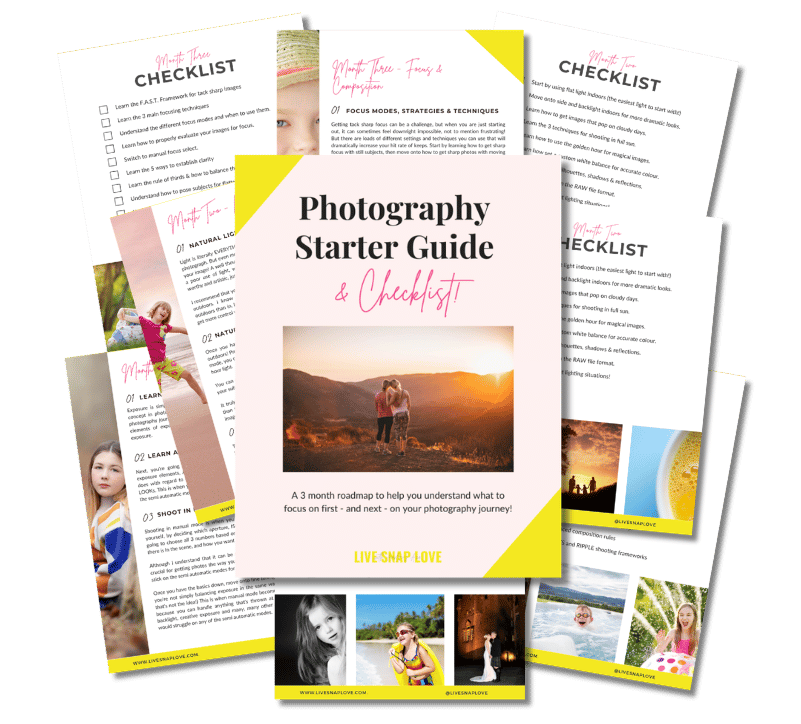
Want to learn photography but have no clue where to begin and what to learn next??!
Steal my Photography Learning Blueprint and get the clarity, checklist and step by step game plan to help you get photos you love - quickly!

How to Use Exposure Compensation
Although I am a strong advocate for shooting in manual mode, as I believe it was only when you fully commit to taking full control that your images turn out the way you want them to, I do realise that there are many people who feel happier using the semi automatic modes (such as AV or TV) instead.
If you are one of these, I urge you to use exposure compensation if you aren't already!
(Actually, I urge you to learn manual mode, but this is the next best thing!)
Righto, let's have a look at what exposure compensation does, and when you might want to use it!

How, When and Why To Use Burst Mode
Most cameras, even point and shoots, have the option of taking photos in burst mode (also called continuous mode) What this mode allows you to do is to take several shots in rapid succession and is very useful for action shots, such as jumping or sports, when it's hard to press the shutter at the exact moment you need. I use it for action shots, like the jumping one above and the running one below, and for things like dancing (like the one of my son dancing in the street at the end!) so that I can make sure that I have the "perfect" moment captured.

RAW vs JPEG - Which Is Right For You?
When shooting with a DSLR, you have two choices of file formats in which to take your image - RAW or JPEG. You may have already heard these two terms bandied about, but not be quite sure which is the best one for you to use so I’m going to briefly go over what the differences are between the two, so you can decide on the best format for you.

5 Ways to Add Punch in Post-Processing
If you shoot in RAW, then you will nearly always want to give your images a little extra "punch" in processing, since these can tend to look a little flat straight out of camera. Pretty much every image will benefit from a little bit of love and tenderness in processing, so here's 5 different ways you can add a little pop when editing your photos!

How to get a blurred background
If there is one thing that people most want to know when they are starting out, it's the trick of getting your subject in sharp focus, whilst leaving the background blurred. This is used a lot in portrait photography, as it allows the subject to really stand out and be the main feature, and I find this is also useful for lifestyle photography, when you are probably working with less than ideal backgrounds.
Getting a blurred background is actually quite simple to do, it just needs a little bit of practice! Here's a step by step guide to what you need to do:

12 Lifestyle Photography Tips for Better Everyday Photos
We all want to more beautifully capture our everyday, so today I'm going to give you some lifestyle \ documentary photography tips!
First of all, let's cover what lifestyle photography actually is. Although everyone has a slightly different take on lifestyle photography - for me, this is about capturing real life, as it happens, and finding the beauty the mundane details of everyday life.
It's basically a style that aims to capture photos that are not posed or staged, but rather real moments, expressions, reactions and details that tell us more about the subject or point in time that a simple portrait photo would.Lifestyle photography is photojournalistic / documentary in style, but with a more artistic approach so that it is far beyond the traditional snapshot!




Check Out These Reader Favourites


It's been quite a few years now since I made the switch from Aperture Priority Mode to shooting in Manual Mode, and it was one of the BEST things I ever did to improve my photography skills.
It was like a whole new world opened up to me, and I started TRULY understanding exposure, and in turn, getting the images that I wanted.
Of course, there was a lot to learn, and there are some things I wish I had known before I started!
So, here are 10 things about shooting in Manual Mode that you might just wish you knew…