Looking for some fun ways to get creative with Christmas light photography? I’ve got three ideas for you to try, all from the comfort of your own home!
We’re getting into the festive spirit here at Live Snap Love, because today I’m sharing three different ways to photograph Christmas lights, each giving you a completely different look!
And the best part? You don’t even need to leave the warmth of your house to try them. Although we’re focusing on photographing Christmas lights indoors, you can use these same techniques with outdoor Christmas lights too.
Just click play on the video below to watch, or if you’d rather read, keep scrolling for the written version!
#1 Making Christmas Lights Twinkle!
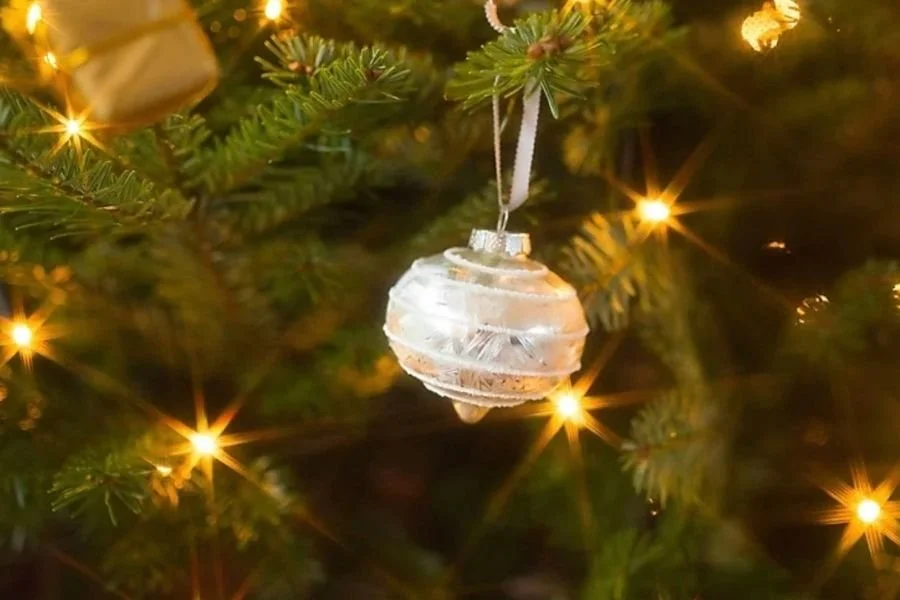
First up in our Christmas light photography ideas is turning those little points of light into beautiful starbursts, just like you can see in the example below!
You can create this effect with the lights on your Christmas tree, fairy lights, or pretty much any small point of light.
And there are two ways to do it: using your camera settings or using a star filter.
Method 1: Create Starbursts Using Your Camera Settings
The trick to creating starbursts is to use a small aperture (large f-number).
I’d suggest starting at around f/16, although you can experiment with f/11 or f/22 to see which gives you the best results with your particular lens.
When you use a small aperture, those little points of light can turn into lovely star-shaped bursts!
To do this, you’ll need to take control of your aperture rather than letting your camera choose it for you.
You can use either Manual Mode or Aperture Priority Mode, as both allow you to select your aperture.
And if you’re still getting to grips with manual settings, you can grab my FREE Manual Mode Cheat Sheet to help you out!
One thing to watch out for: Using a small aperture means less light reaches your camera’s sensor, so you may need a slower shutter speed to get a good exposure.
If you’re photographing your Christmas tree indoors, using a tripod can help keep everything nice and sharp.
Getting star bursts using a filter
The second way to get those lovely twinkling stars is to use something called a star filter.
This is a filter that screws onto the front of your lens and has a special pattern etched into the glass.
That pattern creates the starburst effect for you, regardless of which aperture you’re using!
So instead of needing to shoot at f/16 or f/22, you could use a wider aperture, such as f/4.5 or f/5.6, and still get those lovely star-shaped lights.
This can be particularly useful when you’re photographing Christmas lights indoors and don’t have much light to work with.
Now, I have a star filter myself, and I originally bought the cheapest one I could find.
And I have to say, the really cheap, crappier ones can make your photographs look noticeably softer!
Which is a bit annoying when you’ve spent good money on a lovely sharp lens, only to stick a cheap filter on the front and lose some of that sharpness!
So if this is something you want to do a lot of, I’d personally recommend spending a little more on a decent-quality filter rather than (like ole skinflint me) automatically choosing the cheapest one available!
#2 Photographing Christmas Lights By Making Them Out of Focus
Next up, we’re going to do something a little different and deliberately photograph our Christmas lights out of focus!
This is such a fun, creative way to photograph Christmas lights, and it’s ridiculously easy to do, because pretty much all you need to do is switch your lens from autofocus to manual focus!

How to Photograph Out-of-Focus Christmas Lights
On the side of your lens, you’ll usually find a little switch marked AF (autofocus) and MF (manual focus) - you can see it in the picture I’ve popped in below.
Simply switch it from AF to MF. This stops your camera from automatically focusing for you.
Now, set up your shot as normal, but instead of focusing on the Christmas lights, turn the focusing ring on your lens until the lights become lovely, soft circles of light.
And here’s where you can have some fun!
By turning the focusing ring, you can control just how out of focus your Christmas lights become.
You might want them slightly blurred so you can still make out the shape of your Christmas tree, or you could throw everything completely out of focus for a more abstract photograph.
There’s no right or wrong here, so experiment until you get a look you love!

#3 Create Beautiful Christmas Light Bokeh
For our third and final Christmas light photography idea, we’re going to create some lovely light bokeh!
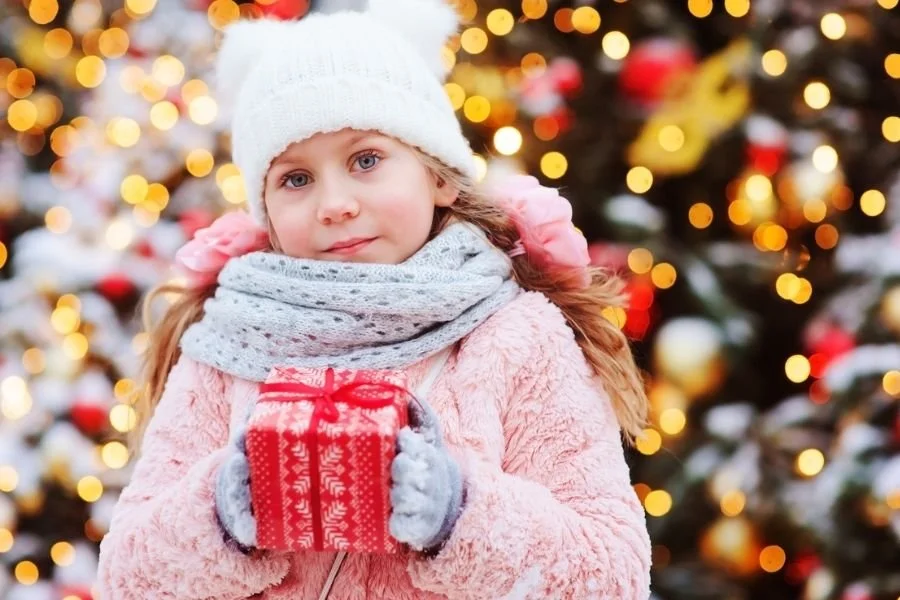
Bokeh is the term we use to describe the appearance of the out-of-focus areas of a photograph. When you have little points of light in the background, such as Christmas tree lights or fairy lights, they can turn into beautiful, soft circles of light.
And unlike our previous technique, where we deliberately blurred the entire scene, this time we’re going to keep our subject nice and sharp while turning those Christmas lights in the background into gorgeous little circles of light.
Just like you can see in the example below!

You can create this effect with just about anything in front of your Christmas lights!
I’ve used a christmas ornament in my example photo here, but you could photograph a person, a Christmas drink, a teddy bear, or anything else you fancy!
The idea is simple: keep your subject in focus while turning the Christmas lights behind them into lovely, soft circles of light.
How to Create Christmas Light Bokeh
Start by placing your subject in front of something with lots of little lights.
Your Christmas tree is perfect for this, but you could also use a wall of fairy lights or any other collection of small points of light.
The more lights you have in the background, the more little circles of bokeh you’ll have to play with!
Next, switch your camera to Manual Mode or Aperture Priority Mode, because you’ll want to choose a large aperture (that’s a small f-number).
I’d suggest starting somewhere around f/2.2 or f/2.8, if your lens allows it.
A large aperture helps create that lovely blurred background, although the exact settings will depend on your lens and what you’re photographing.
Here’s another little tip: Try moving your subject further away from the Christmas lights.
The greater the distance between your subject and the lights, the more blurred those lights can become, giving you bigger, softer circles of bokeh.
Then simply focus on your subject and take your photograph!
If you’re struggling to get enough background blur, I’ve got another tutorial that will help:
👉 How to Get a Blurry Background in Photography
It walks you through the different factors that affect background blur, and you can use those exact same techniques here!
Get Creative with Custom-Shaped Christmas Bokeh!
Now, here’s something else you can try.
Did you know you can actually change the shape of those little circles of light?
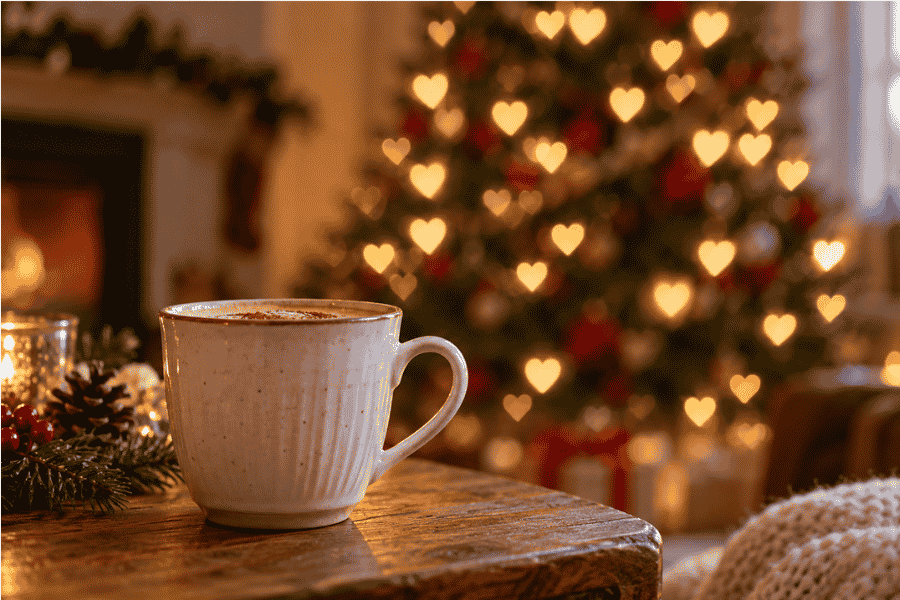
Instead of having round bokeh, you can turn your Christmas lights into hearts, stars, Christmas trees, or other fun shapes!
Just like you can see in the example below.
And the best part? You don’t need any fancy equipment to do it.
You can create your own DIY bokeh filter using little more than some black paper, scissors and tape!
It’s such a fun technique to experiment with, particularly at Christmas when you’ve already got all those lovely twinkling lights to work with.
Now again, you want to be shooting in either manual mode or aperture priority mode for this because you want to be able to choose a large aperture. (That's a small F number) That's what’s going to give you this light bokeh!
Now again, remember that we have the free manual mode cheat sheet that you can download, so go grab it here if you haven’t already, especially if you’re not yet confident choosing your settings!
(I’ve also got another fun Christmas resource for you - my FREE Christmas Photography Prompts that will help you document your December! Just enter your details below and I’ll send it your way immediately!)
4 Quick Tips for Photographing Christmas Lights
Before you grab your camera and start experimenting, I’ve got a few general tips to help you get the best results when photographing Christmas lights!
Tip 1: Keep Your ISO as Low as You Can
When photographing Christmas lights, try to keep your ISO reasonably low whenever possible.
This will help minimise digital noise (that grainy appearance you sometimes see in photographs), giving you cleaner-looking images.
However, don’t be afraid to increase your ISO if you need to, particularly if you’re photographing people or shooting without a tripod.
It’s much better to have a sharp photograph with a little noise than a blurry one because your shutter speed was too slow!
And if you’re not quite sure what causes digital noise or how to avoid it, I’ve got another tutorial that will help:
👉 Why Are My Photos Grainy? (And How to Fix It)
Tip 2: Use a Tripod When Needed
A tripod can be incredibly useful when photographing Christmas lights, particularly if you’re working with slower shutter speeds.
For example, remember how we used a small aperture, such as f/16 or f/22, to create those lovely starbursts?
Because a small aperture lets less light into your camera, you may need to use a slower shutter speed to get a good exposure.
And that’s where a tripod comes in!
It keeps your camera steady, helping you avoid blurry photographs caused by camera movement.
Just remember that a tripod won’t stop your subject from moving, so if you’re photographing people in front of your Christmas lights, you’ll still need a shutter speed fast enough to keep them sharp.
Tip 3: Avoid Using Your Camera’s Built-In Flash
If you’re trying to capture the lovely warm glow of Christmas lights, I’d recommend switching off your camera’s built-in flash.
Why?
Because that direct burst of light can overpower the Christmas lights and completely change the mood and atmosphere you’re trying to capture.
Instead, try making the most of the available light, adjusting your camera settings or using a tripod if necessary.
That way, you can preserve that lovely festive glow!
Tip 4: Experiment with Daytime AND Nighttime Photography
Here’s something you might not have realised: you don’t have to wait until it’s dark to photograph Christmas lights!
In fact, many the example photographs I’ve shown you in this tutorial were taken during the day.
That’s simply because having more available light makes it easier to get the camera settings you want, particularly when you’re experimenting with different apertures.
But don’t stop there!
Try photographing the same Christmas lights at night, too.
You’ll get a completely different look and feel, with the lights standing out much more against the darker surroundings.
Just remember that you’ll have less available light to work with, so you may need to adjust your settings or use a tripod to keep your photographs sharp.
Experiment with both and see which look you prefer!
Now It’s Your Turn!
So there you have it! Three fun and creative ways to photograph Christmas lights, all without having to leave the comfort of your own home!
Whether you’re turning your Christmas tree lights into twinkling stars, experimenting with deliberately out-of-focus images, or creating gorgeous light bokeh, I hope these ideas have inspired you to grab your camera and have a little festive fun!
And if you’re looking for even more Christmas photography inspiration, I’ve got something for you!
🎄 Download my FREE December Daily: 31 Christmas Photography Prompts!
It’s packed with simple, fun photo ideas to help you capture all those lovely little moments, details and traditions that make this time of year so special.
You can use it as a daily photography challenge throughout December, or simply dip in whenever you fancy picking up your camera. Grab your free copy below!
Frequently Asked Questions About Christmas Light Photography
What are the best camera settings for photographing Christmas lights?
The best settings depend on the effect you’re trying to create!
For twinkling starbursts, try a small aperture such as f/16. For soft, blurry Christmas light bokeh, use a wider aperture such as f/2.8.
You can use either Manual Mode or Aperture Priority Mode to control your aperture, and a tripod can be helpful when working with slower shutter speeds.
How do you make Christmas lights look blurry in photos?
If you want to create an intentionally blurry photograph of Christmas lights, switch your lens to manual focus (MF) and turn the focusing ring until the lights become soft circles.
If you’d rather keep a subject sharp with blurry Christmas lights behind it, use a wide aperture and position your subject some distance in front of the lights.
Can you photograph Christmas lights during the day?
Absolutely! In fact, all the example photographs in this tutorial were taken during the day.
Having more available light makes it easier to experiment with different camera settings, particularly when using small apertures to create starbursts.
For a different look, try photographing your Christmas lights at dusk or after dark, when they’ll stand out more against their surroundings.
How do you make Christmas lights look like stars in photographs?
There are two easy ways to create starbursts with Christmas lights.
The first is to use a small aperture, such as f/16 or f/22, which can turn points of light into star-shaped bursts.
The second is to use a star filter, which attaches to the front of your lens and creates the starburst effect even when you’re using a wider aperture.
Both methods are worth experimenting with to see which look you prefer!